NLP Trends 2026: What 116,000 arXiv Papers Show, from LLMs to Agents and Benchmarks
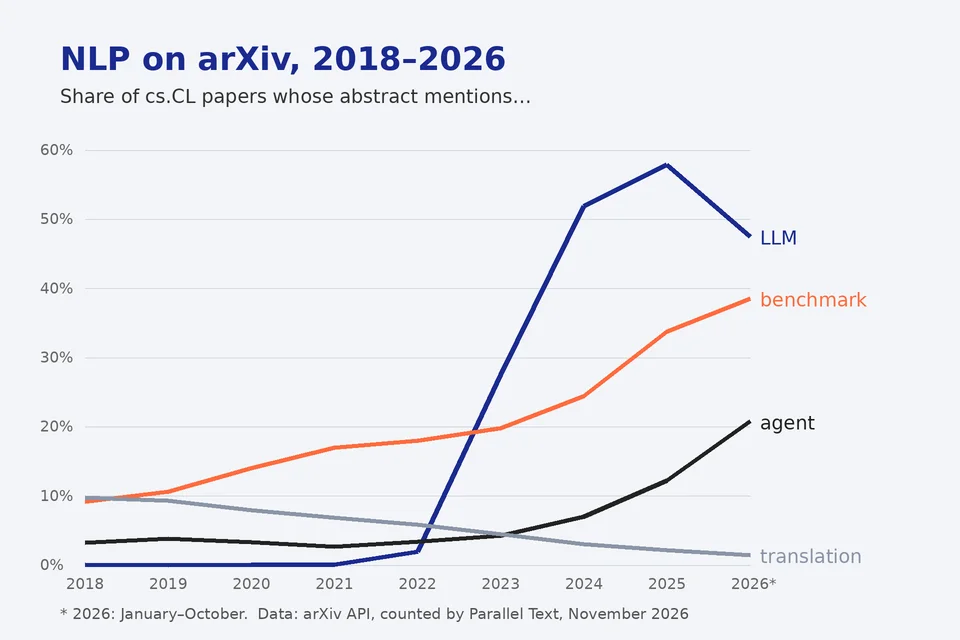
Every year brings a new list of "NLP trends", usually written from a handful of headline models. We wanted a barometer that anyone can check. So we counted: how many papers arXiv's Computation and Language category (cs.CL) received each year since 2018, and how many of their abstracts mention a dozen terms, from "LLM" and "agent" to "machine translation" and "BERT". The picture for 2026 is clear, and a little more nuanced than the hype.
A field that grew six times over
The first trend is size. arXiv's own listing for cs.CL counts 3,729 entries for 2018, including papers cross-listed from other categories, and 23,704 for 2025. Our counts through the arXiv API, which date each paper by its first submission, give almost the same totals.
Added up from January 2018 to October 2026, our counts come to 116,590 papers.
The steepest growth came in 2023 and 2024, the two years after ChatGPT's public release, when annual submissions rose by about half each year. Growth then slowed: 2025 was up roughly 15% on 2024. But it has not stopped. Between January and October 2026 we counted 25,229 cs.CL papers, already more than the 23,767 we counted for the whole of 2025 with the same method.
That growth matters for every other figure in this article. A topic can gain papers every year and still lose ground, because the field around it is expanding faster. This is why we report shares: the percentage of cs.CL papers that mention a term, year by year.
The barometer, term by term
| Term in the abstract | 2018 | 2020 | 2022 | 2024 | 2025 | 2026 (Jan–Oct) |
|---|---|---|---|---|---|---|
| "large language model" | 0.0% | 0.3% | 4.4% | 52.6% | 55.3% | 38.1% |
| "LLM" | 0.0% | 0.0% | 1.9% | 51.8% | 57.9% | 47.5% |
| "agent" | 3.2% | 3.3% | 3.3% | 7.0% | 12.2% | 20.8% |
| "reasoning" | 5.4% | 7.6% | 9.1% | 16.5% | 28.8% | 27.4% |
| "benchmark" | 9.2% | 14.0% | 18.0% | 24.4% | 33.7% | 38.5% |
| "retrieval augmented" | 0.0% | 0.0% | 0.5% | 4.6% | 6.1% | 4.9% |
| "hallucination" | 0.0% | 0.2% | 0.8% | 5.0% | 5.3% | 4.6% |
| "multilingual" | 3.4% | 5.7% | 6.4% | 5.3% | 6.2% | 5.9% |
| "low resource" | 3.5% | 4.4% | 5.2% | 3.4% | 4.1% | 3.3% |
| "machine translation" | 9.8% | 7.9% | 5.8% | 3.0% | 2.1% | 1.4% |
| "BERT" | 0.2% | 13.4% | 8.4% | 3.2% | 2.3% | 1.3% |
| "sentiment" | 6.6% | 6.0% | 4.3% | 2.9% | 2.5% | 1.8% |
Share of cs.CL papers whose abstract contains the term. Full counts for every year from 2018 and all twelve terms are in the CSV below.
Trend 1: LLMs went from niche to default, then lost their capital letters
No term moved like "large language model". In 2022 it appeared in 4.4% of cs.CL abstracts; in 2023, 31.7%; in 2025, 55.3%. The abbreviation followed the same curve, from 1.9% in 2022 to 57.9% in 2025. In 2026 the full phrase drops to 38.1% while "LLM" holds at 47.5%. That is less a retreat than a change of vocabulary: once a technology becomes the default, authors stop spelling it out, and some stop naming it at all. Our guide to what makes a language model open explains why the label itself now covers very different systems.
Trend 2: agents are the fastest riser
"Agent" was a stable, minor term for years: between 2.7% and 4.2% of abstracts from 2018 to 2023, mostly in dialogue and reinforcement learning work. It then climbed to 7.0% in 2024, 12.2% in 2025 and 20.8% in the first ten months of 2026. In raw numbers, 577 papers in 2023 became 5,243 between January and October 2026. Language models that plan, call tools and act over several steps have become one of the main things NLP researchers study, and evaluate.
Trend 3: benchmarks everywhere
"Benchmark" is the quiet giant of this barometer. It appeared in 9.2% of abstracts in 2018, 18.0% in 2022 and 38.5% in 2026. Part of the rise is new datasets designed to test language models; part is that almost every paper now reports scores on several of them.
The Stanford AI Index 2025 describes how quickly scores move: on three benchmarks introduced in 2023, MMMU, GPQA and SWE-bench, scores rose by 18.8, 48.9 and 67.3 percentage points respectively a year later.
That speed is also a weakness. Benchmarks saturate, leak into training data and reward tuning to the test. We look at these problems in our articles on benchmark data contamination and on evaluating NLP models.
Trend 4: reasoning, retrieval and hallucination
Three terms describe what researchers try to make language models do better. "Reasoning" rose from 9.1% of abstracts in 2022 to 28.8% in 2025, and stays at 27.4% in 2026. "Retrieval augmented", the phrase behind retrieval-augmented generation (RAG), went from 0.5% to 6.1% over the same period. "Hallucination" peaked at 5.3% in 2025. Together they sketch the research agenda of the post-ChatGPT years: make models think in steps, ground them in documents, and measure when they invent things. Our explainer on retrieval-augmented generation covers the second of these.
Trend 5: what is fading
Two former stars are in steady decline as a share of the field. "Machine translation" was in 9.8% of cs.CL abstracts in 2018 and 1.4% in 2026; the number of papers peaked at 622 in 2024 and has fallen since. Translation has not disappeared, but much of it is now done with general-purpose models and described in other terms. "BERT", the model that defined NLP from 2019 to 2021, peaked at 13.4% of abstracts in 2020 and is down to 1.3%. "Sentiment" analysis, a classic task, has fallen from 6.6% to 1.8%.
Trend 6: multilingual work holds its ground
One group of terms did not shrink as a share of the field. "Multilingual" appeared in between 5.3% and 6.8% of abstracts every year from 2020 to 2026, and "low resource" in between 3.3% and 5.2%. In absolute terms both more than doubled between 2022 and 2025. With the field growing so fast, holding a stable share means many more papers on languages other than English, a theme we follow in our articles on low-resource languages and on how many languages machine translation covers.
What this barometer does not show
- It counts mentions, not importance. A paper that cites "BERT" once as a baseline counts the same as a paper about BERT.
- arXiv is not the whole field. Many NLP papers are posted there before or after peer review, but not all; the ACL Anthology holds the reviewed record of the main venues.
- Search is approximate. arXiv's search engine matches word variants: "agent" also finds "agents", "benchmark" finds "benchmarks". Phrases such as "large language model" must appear as a phrase.
- 2026 is incomplete. Our 2026 figures cover January to October; shares are comparable across years, raw counts are not.
Method
Data. We queried the public arXiv API on 26 November 2026. For each calendar year from 2018 to 2025, and for 1 January to 31 October 2026, we requested the number of results for cat:cs.CL restricted by submission date, then the same with each term searched in the abstract (abs:), for example abs:agent AND cat:cs.CL. A paper is counted in cs.CL if that category is its primary category or one of its cross-lists, and is dated by its first version.
Terms. large language model, LLM, retrieval augmented, agent, hallucination, reasoning, multilingual, low resource, machine translation, BERT, benchmark, sentiment. Multi-word terms were searched as exact phrases.
Checks. Our yearly totals for cs.CL match the totals shown on arXiv's yearly listing pages to within 0.5%. The query syntax is documented in the arXiv API user manual.
Data download. All counts and shares, one row per term and year with the exact query: nlp-trends-arxiv-cs-cl-2018-2026.csv. Free to reuse with a link to this page; please cite "Parallel Text, NLP trends barometer, November 2026". We plan to update this page each year at the same address.
Sources
- arXiv, "Computation and Language, 2018" and "Computation and Language, 2025", yearly listings, consulted 26 November 2026.
- arXiv, "arXiv API User's Manual", query syntax and fields.
- Stanford Institute for Human-Centered AI, "The 2025 AI Index Report", 2025.
- ACL Anthology, aclanthology.org, the archive of peer-reviewed papers in computational linguistics.
 Methods & evaluation
How NLP models are evaluated
Splits, F1, leaderboards, significance tests and contamination: how to read an NLP evaluation, and how to run one you can trust.
 Methods & evaluation
Benchmark contamination
A model that has already read the exam scores well on it. How test sets leak into web-scale training data, how researchers try to prove it, and what keeps a benchmark honest.
 Methods & evaluation
Retrieval-augmented generation
A language model that looks things up before it answers. How retrieval is done, where it breaks, and how to measure each half.