Word Sense Disambiguation: How Machines Decide What a Word Means
"She sat on the bank" and "she called the bank" use the same word for two unrelated things. People resolve this without noticing; machines have to be taught. Word sense disambiguation, the task of choosing the intended meaning of a word in context, is one of the oldest problems in natural language processing, and a useful lens on how the field has changed.
What exactly is a "sense"?
To disambiguate, you need a list of possible meanings. Most English WSD research uses WordNet, the lexical database started at Princeton University in 1985 under the psychologist George A. Miller, which groups words into sets of synonyms ("synsets") linked by relations such as "is a kind of". WordNet is very fine-grained: a common noun can have many senses that differ only slightly. That precision is valuable for linguists but makes the task hard, because even trained human annotators often disagree about which of two close senses applies. Researchers therefore sometimes evaluate on coarser groupings of senses as well.
The choice of inventory is not neutral. A system can only be as good as the distinctions its dictionary draws, and an inventory designed for English does not map one-to-one onto other languages. Multilingual inventories, which link senses across languages, are discussed in our article on multilingual lexical knowledge bases.
From dictionaries to statistics
Knowledge-based methods
In 1986 Michael Lesk proposed a simple idea at the SIGDOC conference: pick the sense whose dictionary definition shares the most words with the definitions of the surrounding words. His paper's famous example asked how a program could tell a pine cone from an ice cream cone. Variants of the Lesk algorithm, and graph-based methods that walk the links of a lexical network to find the senses most connected to the context, form the family of knowledge-based approaches. They need no annotated training text, only a well-structured lexical resource.
Supervised methods
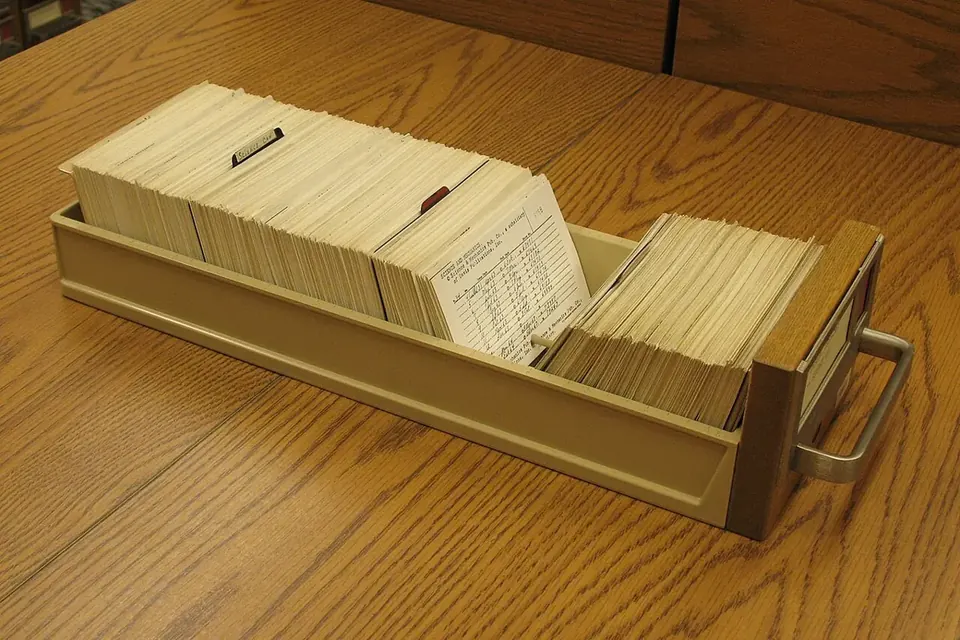
Supervised WSD treats each ambiguous word as a classification problem: given features of the context, predict the sense label. It requires text in which words have been manually tagged with senses. The best-known English resource is SemCor, a portion of the Brown Corpus annotated with WordNet senses by the Princeton team in the early 1990s. Manual sense annotation is slow and expensive, which is known as the "knowledge acquisition bottleneck" of WSD: there is never enough tagged data for every word, let alone every language.
Unsupervised and weakly supervised ideas
David Yarowsky's 1995 ACL paper showed that a few seed examples could be expanded automatically using two regularities: a word tends to keep one sense throughout a document ("one sense per discourse") and in a given collocation ("one sense per collocation"). Such observations still inform how training data is gathered.
The neural turn
Word embeddings of the early 2010s gave each word a single vector, which blurs senses together. Contextual representations changed that. ELMo, presented by Matthew Peters and colleagues in "Deep Contextualized Word Representations" (NAACL 2018), and BERT a year later produce a different vector for each occurrence of a word, depending on its sentence. A simple but effective WSD method follows: compute an average contextual vector for each sense from annotated examples, then label a new occurrence with the sense whose vector is closest. Later systems also feed the sense definitions themselves into the model, which helps with rare senses that have few or no annotated examples.
A related benchmark, the Word-in-Context (WiC) dataset of Mohammad Taher Pilehvar and Jose Camacho-Collados (NAACL 2019), asks only whether a word has the same meaning in two sentences, without any sense inventory. It was included in the SuperGLUE benchmark, a sign that sense distinctions were considered a meaningful test of language understanding.
How WSD is evaluated
From 1998 the Senseval campaigns, later renamed SemEval, organised shared tasks in which teams ran their systems on the same unseen, sense-annotated test sets. Because these datasets used different WordNet versions and formats, comparisons were messy. In 2017 Alessandro Raganato, Jose Camacho-Collados and Roberto Navigli published "Word Sense Disambiguation: A Unified Evaluation Framework and Empirical Comparison" (EACL 2017), which converted the main English all-words test sets and training corpora to a common format; it became a standard reference point for English WSD.
Three practical points help when reading WSD results:
- The most frequent sense baseline is strong. Many words have one dominant meaning, so always choosing the sense that is most frequent in annotated data scores well. A system that barely beats it may be learning little about context.
- Rare senses tell the real story. Overall accuracy can hide poor performance on the less frequent senses, which are exactly the ones where disambiguation matters. Look for results broken down by sense frequency.
- Training and test overlap. When the same sense-annotated sentences or very similar ones occur in both training and test data, scores are inflated, a general problem discussed in our article on evaluating NLP models.
Is WSD still needed?
Large language models rarely run an explicit WSD step, yet they implicitly resolve many ambiguities, which is one reason modern machine translation handles "bank" far better than older systems did. Ambiguity has not disappeared, though. It still shows up in translation errors involving rare senses and specialist vocabulary, in search engines that confuse an entity with a homonym, and in gender and role ambiguities when translating into languages that mark them grammatically.
Explicit sense labels also have advantages a neural model's internal state lacks. They are inspectable: an analyst can see which meaning was chosen and why. They connect text to structured knowledge, such as a database of entities or a terminology bank. And because a sense inventory can be linked across languages, a disambiguated word in one language can be mapped to its equivalent in another without parallel text. These properties keep WSD and related tasks such as entity linking relevant, particularly in lexicography, digital humanities, terminology management and multilingual information access.
Where to start
- Pick an inventory that matches your purpose. Fine-grained WordNet senses suit lexical research; coarser distinctions or domain-specific terminologies often suit applications better.
- Measure the most-frequent-sense baseline first, on your own data, before trying anything more complex.
- Check the tokenization of multiword expressions. Senses often belong to phrases ("ice cream", "kick the bucket") that a tokenizer splits; see how tokenization works.
- Report results by sense frequency and state which inventory version and test sets were used.
Sources
- Lesk, "Automatic sense disambiguation using machine readable dictionaries: how to tell a pine cone from an ice cream cone", SIGDOC 1986.
- Miller, "WordNet: A Lexical Database for English", Communications of the ACM, 1995; WordNet project, Princeton University.
- Yarowsky, "Unsupervised Word Sense Disambiguation Rivaling Supervised Methods", ACL 1995.
- Peters and colleagues, "Deep Contextualized Word Representations", NAACL 2018 (ACL Anthology N18-1202).
- Pilehvar and Camacho-Collados, "WiC: the Word-in-Context Dataset for Evaluating Context-Sensitive Meaning Representations", NAACL 2019.
- Raganato, Camacho-Collados and Navigli, "Word Sense Disambiguation: A Unified Evaluation Framework and Empirical Comparison", EACL 2017 (ACL Anthology E17-1010).
- Navigli, "Word Sense Disambiguation: A Survey", ACM Computing Surveys, 2009.
 Multilingual & low-resource
Multilingual lexical knowledge bases
WordNets, BabelNet, Wikidata and ConceptNet: how meanings are linked across languages, what NLP uses them for, and where they fall short.
 Methods & evaluation
How NLP models are evaluated
Splits, F1, leaderboards, significance tests and contamination: how to read an NLP evaluation, and how to run one you can trust.
 Methods & evaluation
How tokenization works
Why models read text in pieces, how BPE, WordPiece and SentencePiece split words, and why the same sentence costs more tokens in some languages.